 Virtual Colossus
What was the Dragon?
The Dragon was a machine built in America in 1944. It was one of a few machines known as Rapid Analytic Machinery (RAM), built by the Signal Security Agency (SSA) at Arlington Hall, Virginia. It was created to help break “Tunny”, the British name for the Lorenz SZ40/42 cipher attachment.
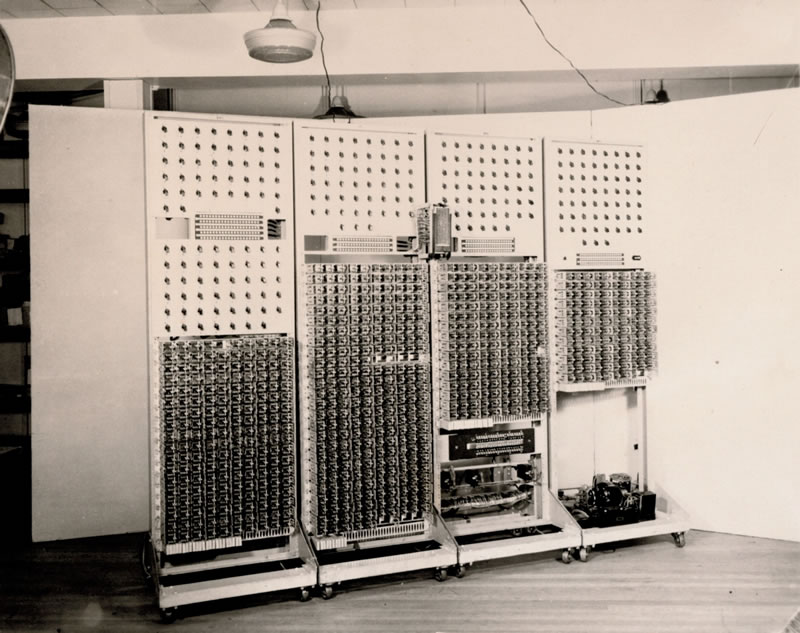
Dragon was designed by Captain George at the SSA, an expert in telephone switching systems. It was completed on 24 August 1944 and shipped to Bletchley Park, arriving on 14 October 1944. It was installed in rooms 22, 23 and 24 of Block F, which were made into one larger room to hold it.
Dragon was a crib-dragging machine: it tested a guess at a section of text believed to be in the enciphered message being tested. If the guess was successful and a match was found, it gave the cryptographers in the Testery the foothold they needed to break into the message and work back to its beginning. Recovering the start of the message gave the start positions of the Psi wheels for that message, so the whole message could then be deciphered on one of the British Tunny machines.
Many messages could be deciphered by hand by the codebreakers in the Testery, but on low-dottage days (days when the motor (Mu) wheels had few dots), it was much harder to find a break, and this is where Dragon was brought into play.
What was the Dragon built to decipher?
To understand how the Dragon worked, it helps first to understand a little about the machine it was built to help break: the Lorenz SZ40/42, a formidable cipher machine used by the German High Command to send top-secret enciphered teleprinter messages to and from the top generals on the battle fronts.
The Lorenz had twelve wheels, used to generate two separate key letters for each letter of the message being sent. The wheels were in three sections: the first five were called the Chi wheels (pronounced with a hard C, like K, to rhyme with “try”), the next two the Mu (or motor) wheels, and the last five the Psi wheels (pronounced “sigh”). The two generated letters were “added” to the letter being sent, using a method invented by Gilbert Vernam in 1918. This gave a final enciphered letter, sent by wire or radio to another Lorenz machine at the receiving end. The receiving Lorenz, with its wheels set to the same start positions as the sending one, added the same two letters back on, revealing the original message.
To find out more about the Lorenz and how it encoded messages, take a look at my other site, Virtual Lorenz, which has a simulation of the Lorenz and more detail on how it worked.
For example, say we’re sending the letter M. The Lorenz generates two letters: here the Chi wheels give X and the Psi wheels give R. The machine adds these two letters together to give a further letter, here Q (X + R = Q). This is then added to the letter being sent, M, giving J (M + Q = J). The important thing is that the order of the additions doesn’t matter: we could add M + X, then add R, and still get J.
To decipher the received letter J, the same two letters from the Psi and Chi wheels are added to it. Again, the order doesn’t matter, and the result is the original letter: J + X + R = M.
Purpose and method
This is an extract from the Newmanry History, part of the General Report on Tunny (1945), 55A, page 363:
“The purpose is to set a common crib P, of up to 10 letters, in a given de-chi D, i.e. to find a stretch of D (if there is one) where the underlying plain text is P, so that P + D = PSI′, which when the extensions are removed, yields PSI.
Dragon adds P to a stretch of D in all positions in turn: in each position it contracts P + D, i.e. omits repeated letters, and then compares each impulse of the result, independently, with the corresponding PSI wheel: if all five can be fitted the machine stops and displays the settings of D and all PSI’s at the last letter of the crib.”
Over the next pages, I’ll try to explain what this means and how Dragon did its job.
The part of the General Report on Tunny that covers the machines used at Bletchley Park (Colossus, Robinson, Dragon and others) was scanned and made available by the late Tony Sale on his website, codesandciphers.org.uk, if you want to know a little more.
Generating the input
Dragon didn’t work on the original enciphered message, but on a version with one part stripped off: the part generated by the Chi wheels. The input for Dragon was therefore called a de-chi.
Each time the Lorenz pin settings were changed (how often varied through the war, and some wheels were changed more often than others), the cryptographers in the Testery at Bletchley Park, people like Captain Jerry Roberts, worked out the pin settings of the wheels by hand.
The de-chi was then usually generated by Colossus, which began breaking into the message with Bill Tutte’s “1+2 break-in”, to find the start positions set for that message. See Virtual Colossus for more on how this was done. Colossus could go on to break the Mu and Psi wheels too, but it seems it was a better use of its time to move on to another message and leave the final decrypt to other machines and to the Testery’s hand methods.
This initial break gave everything needed to generate the same pattern of Chi wheel letters as the Lorenz, and adding these letters to the original message gives a de-chi. Remember, PLAIN + CHI + PSI = CIPHER and, likewise, CIPHER + CHI + PSI = PLAIN. So adding just the Chi to the cipher message gives CIPHER + CHI = PLAIN + [CHI + CHI, which cancel out] + PSI = PLAIN + PSI. This is our de-chi: the plain text with only the Psi part of the key still added to it.
The resulting de-chi was punched onto paper tape, ready to be read into Dragon by a standard Teletype Model 14TD tape reader. The reader was probably wired to read the five impulses straight in, in parallel, rather than converting them to a series of pulses (its normal output).
A Teletype 14TD, showing how it can be started and stopped to show the current de-chi letter being read. Dragon was probably wired to it, to stop it when a result was found.
Next: how Dragon tested the crib.